Jujutsu fits how coding agents actually work.

Agents work concurrently, rewrite earlier steps, rebase stacks, and hit conflicts mid-flight. Git turns those moments into branch choreography and interrupted commands. Jujutsu makes the working copy a Change, keeps its identity through rewrites, rebases descendants automatically, and records conflicts as inspectable state.

The practical difference

Git makes agents manage branches. Jujutsu lets them manage Changes.

A Change is the piece of work itself. It can evolve, move, split, stack, and conflict without losing its identity. That is a better primitive for agents that iterate continuously and work in parallel.

01

An agent starts a task

Git workflow

Create and name a branch, make sure it points at the right base, then keep the branch and worktree paired for the life of the task.

Jujutsu / Vex workflow

Create a workspace. Its working copy is already a mutable Change in the shared graph; no task branch is required.

Why agents care

Agents get isolated directories without a parallel branch-naming system.
02

The agent edits an earlier step

Git workflow

Create a fixup commit, remember its target, run an interactive autosquash rebase, and repair every descendant if the rewrite changes them.

Jujutsu / Vex workflow

Move the edit into the Change it belongs to. Jujutsu automatically rebases every descendant onto the rewritten result.

Why agents care

The graph absorbs iteration without turning cleanup into another task.

03

Main moves under a 4-change stack

Git workflow

Rebase the branch chain in the right order. A conflict pauses the command and leaves the repository inside a special rebase state.

Jujutsu / Vex workflow

Rebase the mutable stack as one graph operation. Descendants follow their parents automatically, even when a Change becomes conflicted.

Why agents care

One explicit operation updates the stack; there is no rebase choreography per branch.

04

Two agents touch the same code

Git workflow

The merge or rebase stops. Resolve everything now, continue or abort correctly, then reconstruct what the command was trying to do.

Jujutsu / Vex workflow

The operation succeeds and records a logical conflict in the affected Change. That Change can still be inspected, moved, rebased, or backed out.

Why agents care

A conflict becomes visible work to schedule, not a mode that traps the workspace.

05

An agent makes the wrong history edit

Git workflow

Search reflogs, identify every ref that moved, and choose the right reset or recovery sequence without losing newer work.

Jujutsu / Vex workflow

Inspect the repository-wide operation log and undo the operation, or restore the complete repository view from an earlier point.

Why agents care

Recovery is based on the action that happened, not on reverse-engineering ref movement.

06

The patch needs to be split for review

Git workflow

Move hunks through the index, partial commits, resets, and temporary fixups while keeping the intended branch history in your head.

Jujutsu / Vex workflow

The working copy is already a Change. Split it into sequential Changes or squash selected files and hunks into the Change that owns them.

Why agents care

Review structure is modeled with Changes instead of staging-area state.

07

The Change is rewritten repeatedly

Git workflow

Every amend creates a new commit SHA. Humans and tools need a branch or pull request to infer that the new commit is the same piece of work.

Jujutsu / Vex workflow

The commit ID changes, but the Change ID normally stays stable. Vex carries that identity into patchsets and hosted review.

Why agents care

Agents can iterate aggressively without losing the durable identity reviewers follow.

08

Several commands touch the repository at once

Git workflow

Repository locks serialize sensitive mutations, and concurrent automation often needs retry logic around shared mutable state.

Jujutsu / Vex workflow

The operation log records divergent operations and reconciles concurrent repository views instead of corrupting the repository.

Why agents care

The source model expects concurrent actors—the normal condition for agent-led work.

Agent workspaces

One repository. Many agents. No branch factory.

Jujutsu supports multiple working copies backed by one repository. Vex wraps that primitive with workspace policy and setup hooks, so each agent gets an isolated directory and its own working-copy Change in the same graph.

Git worktrees can also isolate directories. The difference is what happens next: Jujutsu tracks each workspace's working copy as a Change instead of requiring a branch to carry the task's identity.

Git worktree setup

$ git worktree add ../fix-auth -b agent/fix-auth
$ git worktree add ../billing -b agent/billing
$ git branch --list 'agent/*'

Vex / Jujutsu workspace setup

$ vex ws create fix-auth
$ vex ws create billing
$ vex ws list

fix-auth@

Agent 1

Mutable Change

billing@

Agent 2

Mutable Change

review@

Human

Independent view

Whole-stack rebase

Main moved. Rebase the graph once.

Imagine 3 agents building one dependent feature. The schema supports the API; the API supports the UI. Main advances before review.

In Git, the team must preserve that branch chain while replaying it. In Jujutsu, the dependencies already live in the commit graph. Move the mutable stack and descendants follow their rewritten parents automatically.

Refresh main + replay the current stack

$ vex pull --rebase --dest main

One dependent stack

main moved
A

Schema Change

Agent 1

rebased onto main
B

API Change

Agent 2

follows Change A
C

UI Change

Agent 3

follows Change B
Rewrite A → Jujutsu automatically rebases B and C.
First-class conflicts

A conflict is data, not a crashed command.

When a rebase cannot combine 2 edits, Jujutsu records the logical conflict in the resulting Change and finishes the operation. The conflict is now a native, inspectable state in the graph.

The rebase still completes

There is no half-finished rebase session to continue or abort. The affected Change is marked conflicted; unaffected work remains usable.

The conflict can move through the graph

A conflicted Change can be rebased again, merged, checked out, or backed out. Jujutsu stores the logical sides, not nested marker text.

Resolution becomes schedulable agent work

Another agent or a human can inspect the conflicted Change, resolve all or part of it, and review the resolution as an ordinary diff.

Find conflicted Changes

$ vex log -r 'conflicts()'

Step back one repository operation

$ vex undo
Undo for the whole repository

Let agents try things without making recovery heroic.

Git reflogs record ref movement. Jujutsu's operation log records the complete repository view after every operation: Changes, bookmarks, heads, and each workspace's working-copy Change. Undo targets the action, not one ref at a time.

$ vex op log

See what every command changed

Inspect repository operations in order, including concurrent or divergent operations.

$ vex undo

Reverse the last operation

Step back without first calculating which branches, commits, and working copies moved.

$ vex op restore <id>

Restore a known repository view

Return the complete repository to an earlier operation when a larger experiment went wrong.

Running product

Local Change identity continues into hosted review.

Jujutsu provides the local graph. Vex gives that Change a durable hosted number, patchset history, checks, review state, and dependency-aware landing.

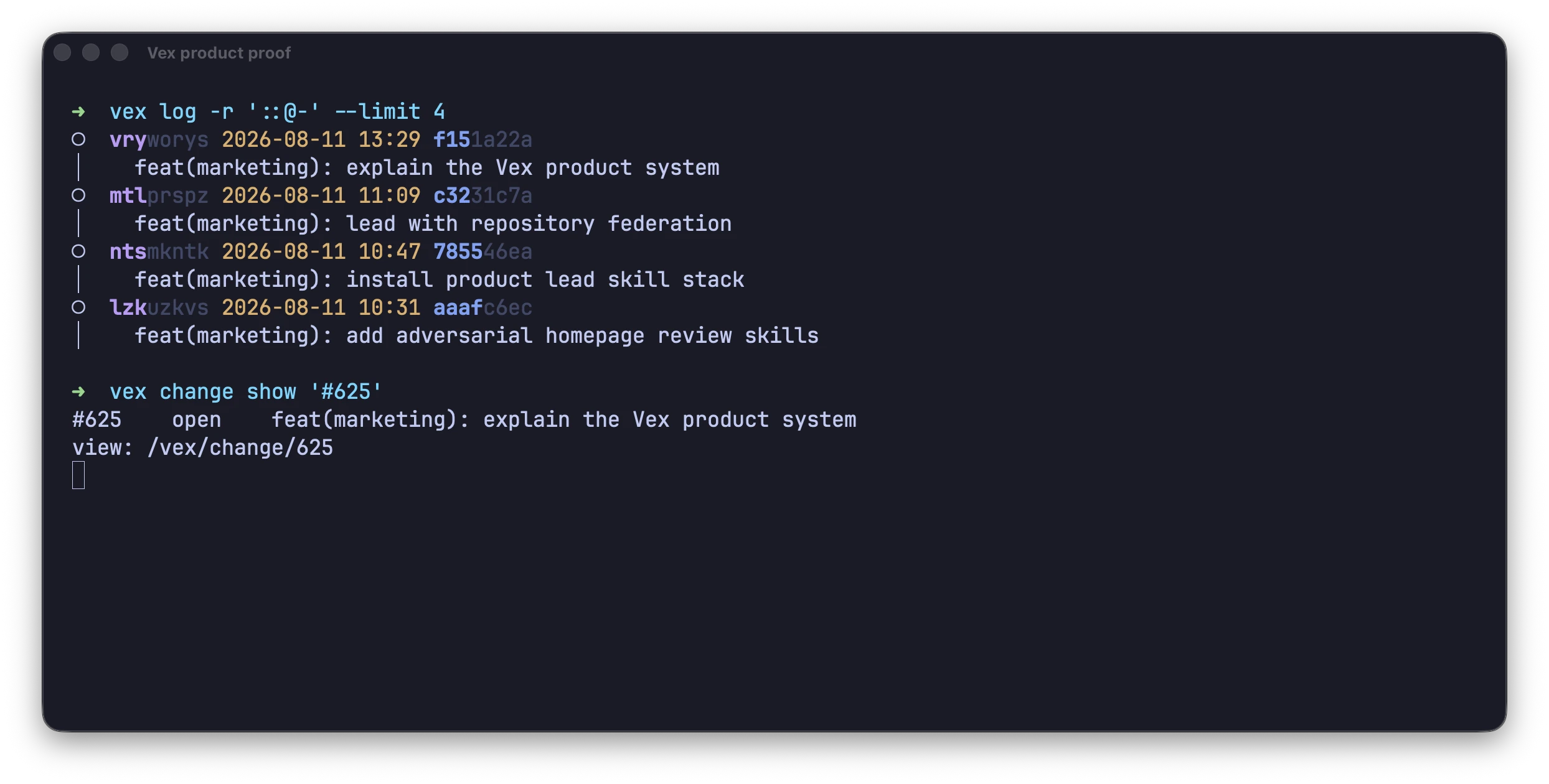
A full-colour Ghostty window running vex log for four related changes, then vex change show for hosted Change 625 in the Vex monorepo.

Local source graph

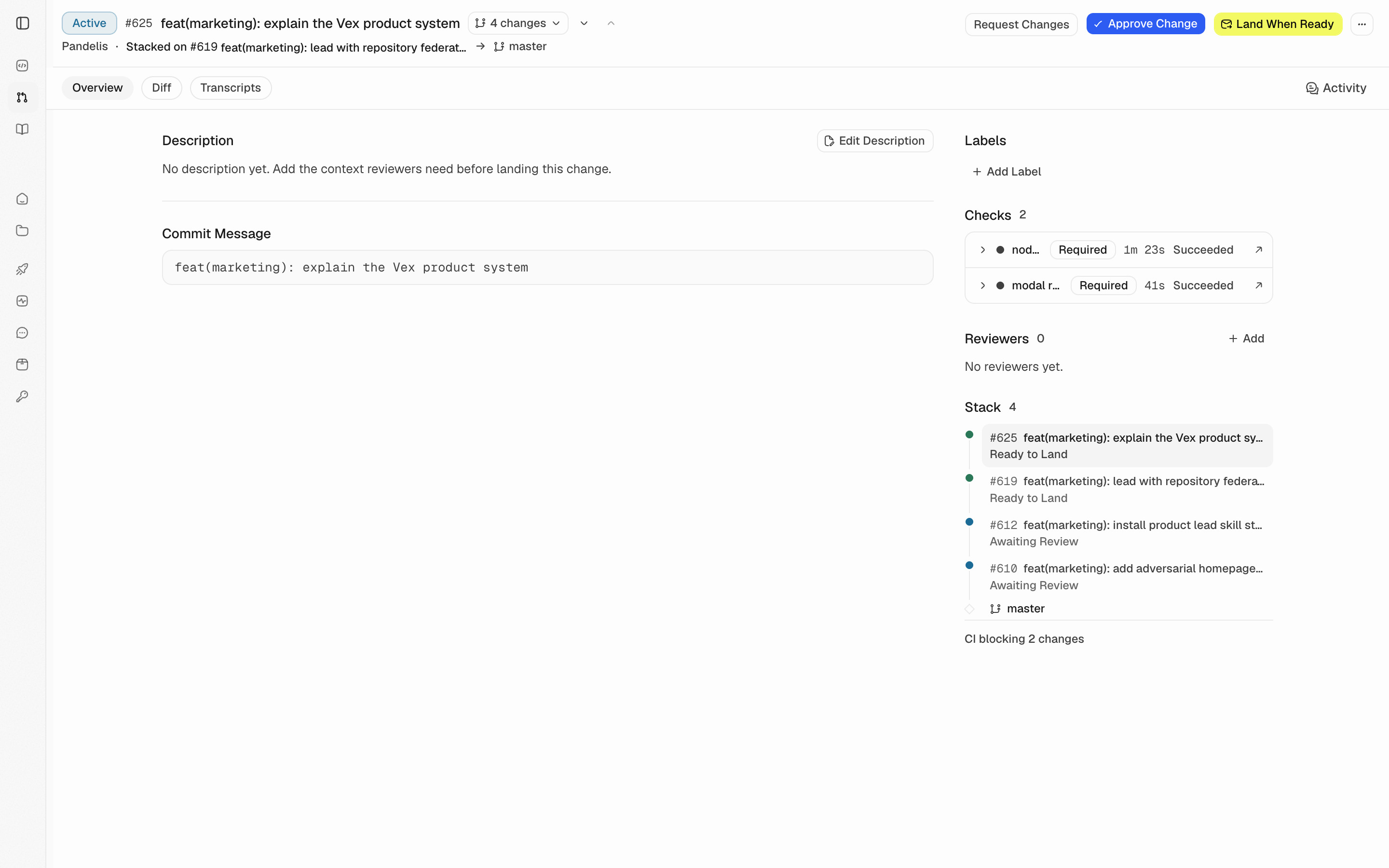
The local Jujutsu graph and hosted review surface refer to the same durable Change #625.

This capture proves identity continuity; it is not a performance comparison with upstream Jujutsu or Git.

Ghostty · vex log + vex change show '#625'
Vex organization · 11 Aug 2026

The hosted Vex page for Change 625, with two succeeded checks and a four-member dependency rail matching the Change shown in Ghostty.

Hosted review

That same Change carries checks and its position in the dependency chain once hosted.

/vex/change/625
Vex organization · 11 Aug 2026

Jujutsu does not eliminate difficult merges or make every concurrent edit compatible. It makes the conflict explicit, movable, inspectable, and undoable so the workflow can keep operating around it.

Start with proof

Run one agent stack without branch choreography.